
Risk
P2P Lending: Returns and Risks – where high interest comes from and when it gets dangerous
P2P loans advertise 6 to 24 % returns. Where the interest actually comes from, what risks investors carry – and what the Ventus Energy collapse in 2026 teaches us.

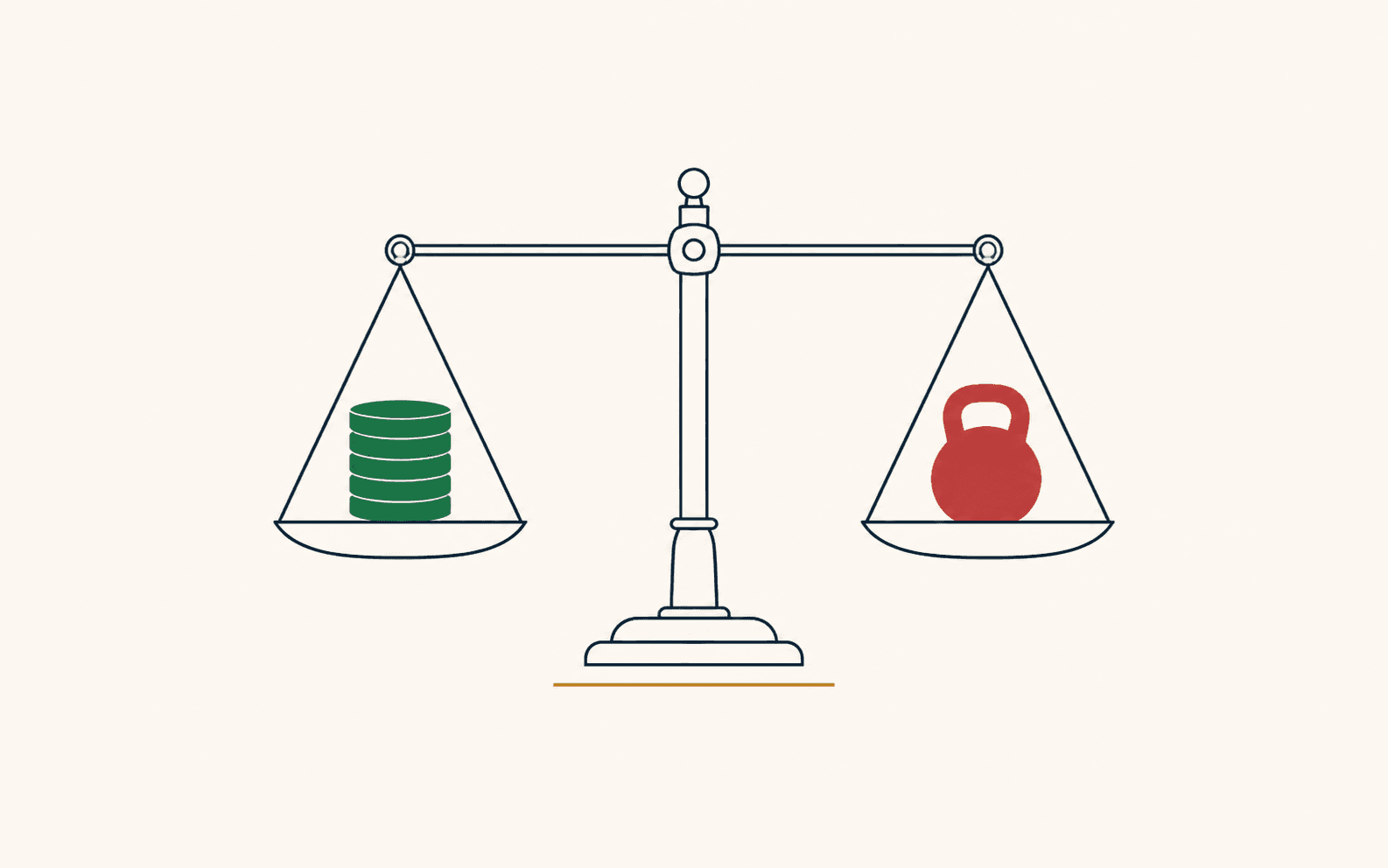
P2P loans realistically yield 6 to 14 % interest per year depending on the platform — after defaults, fees and taxes, net returns tend to land between 3 and 9 %. And yes, they are risky: there is no deposit insurance, and a total loss is possible. Return and risk are directly linked — the interest rate is the price the market pays for risk. Understanding that lets you evaluate offers properly. Ignoring it leads to platforms like Ventus Energy, which entered restructuring in 2026 with over 94 million euros of investor money — after advertising up to 24 % interest.
How high are the returns on P2P loans?
Advertised interest rates differ sharply by loan type and protection mechanism. Broadly, four segments can be distinguished:
Cash-park products (around 6 %): Products like Bondora Go & Grow pay a fixed interest of up to 6 % per year with daily availability. The return is low because the product sells liquidity and smoothed volatility — yet the default risk of the underlying loan portfolio is still borne by the investor.
Consumer loans with buyback guarantee (8–12 %): the largest and best-known group. Marketplaces like Mintos, PeerBerry or Robocash bundle short-term consumer loans, usually with a buyback guarantee from the lending company. Mintos as European market leader reports an average net return of around 10 to 12 %; the other providers typically sit at 8 to 11 %.
Secured loans (9–12 %): Providers like EstateGuru (real estate) or LANDE (farmland and crops) back their loans with physical assets. Returns are around 9 to 12 % — the collateral cushions the loss risk but does not eliminate it, because a default outcome depends on the recovery proceeds.
Subordinated project financing (15–24 %): Energy and real estate projects, often structured as subordinated loans. Ventus Energy advertised 18 to 24 %. This segment carries the highest risk — more on that below.
The difference between advertised and realised return matters: from the gross rate, deduct defaults not covered by a buyback guarantee, uninvested waiting periods between loans (cash drag), payments that are overdue but not yet written off — and finally withholding tax. In practice, net returns are often 30 to 50 % below the advertised figure.
Where the return comes from: the money chain
The fact that P2P platforms can pay double-digit interest is neither magic nor fraud — it follows from the chain of participants. At the start is a borrower who cannot get a loan from their bank, or not quickly enough. Depending on country, term, and credit quality, that borrower pays effective annual interest of 20 % to well over 100 % — short-term small loans in Eastern Europe or Southeast Asia regularly sit at the upper end of that range.
That money is distributed across every link in the chain: the loan originator issues the loan, keeps the difference between borrower rate and investor rate as margin, and funds defaults and the cost of the buyback guarantee from that margin. The platform earns fees from loan originators or investors. The investor receives their 8 to 12 % at the end — as compensation for providing capital and bearing the residual risk.
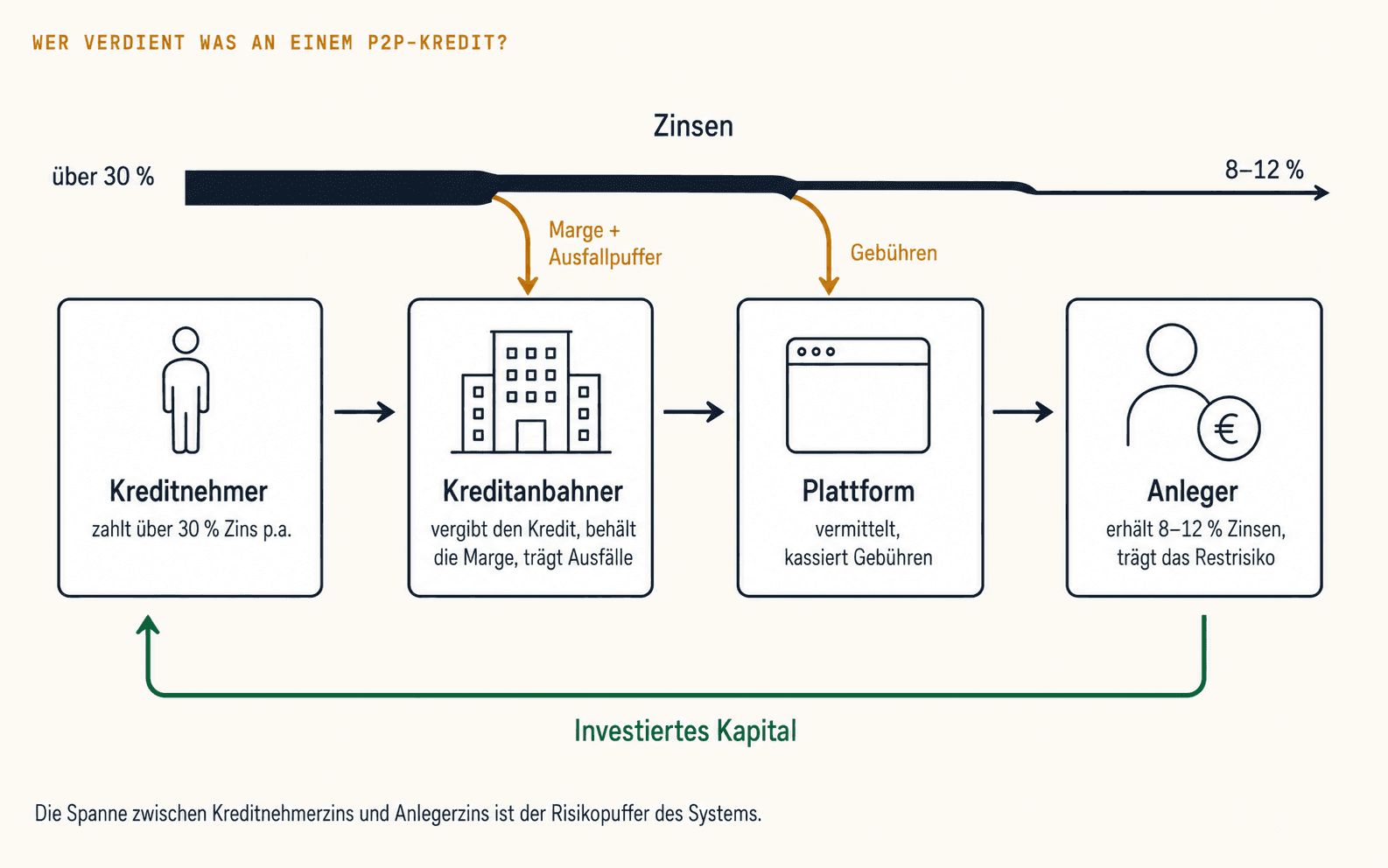
The spread between what the borrower pays and what reaches the investor is also the system's risk buffer. When defaults rise, the loan originator's margin shrinks first — then the buyback guarantee wobbles, and ultimately the investor is left exposed. For a detailed look at how this marketplace works, see our guide P2P Lending Explained.
Are P2P loans risky? The six risk types
Yes — and on several levels simultaneously. The interest figure always reflects a bundle of several risks that can materialise independently of one another:
1. Default risk
The most obvious risk: the borrower does not repay. It can be controlled by spreading across many loans, but not eliminated.
2. Loan originator risk
If the loan originator fails, its buyback guarantee is worthless — and with it often the supposedly protected portfolio. When many loans come from the same corporate group, spreading across hundreds of individual loans offers little protection.
3. Platform risk
The platform itself can become insolvent, freeze withdrawals, or cease operations. The loan contracts technically continue to exist, but recovering capital is slow and uncertain — especially when the platform is based abroad.
4. Liquidity risk
P2P loans are not available daily. Secondary markets are thin and thinnest during stress phases — exactly when everyone wants to sell. At Ventus Energy, the "Early Exit" function was suspended entirely in June 2026.
5. Regulatory and legal risk
How is the investment legally structured? Subordinated loans place investors at the end of the creditor queue in an insolvency. And if a platform operates without the required licence, regulators can stop the business at any time — which briefly protects investors but can further destabilise an already struggling platform.
6. Fraud risk
Manipulated figures, inflated valuations, transactions with related parties: P2P platforms are not subject to a prospectus obligation like listed issuers. Cases such as Envestio and Kuetzal (both 2020) showed that a polished website can be a fraud vehicle.
No deposit protection – total loss possible
P2P loans are not covered by statutory deposit insurance. If any of the risks above materialises, the capital invested can be lost in full. Only invest money you can afford to lose.
What happens to my money if a P2P platform goes insolvent?
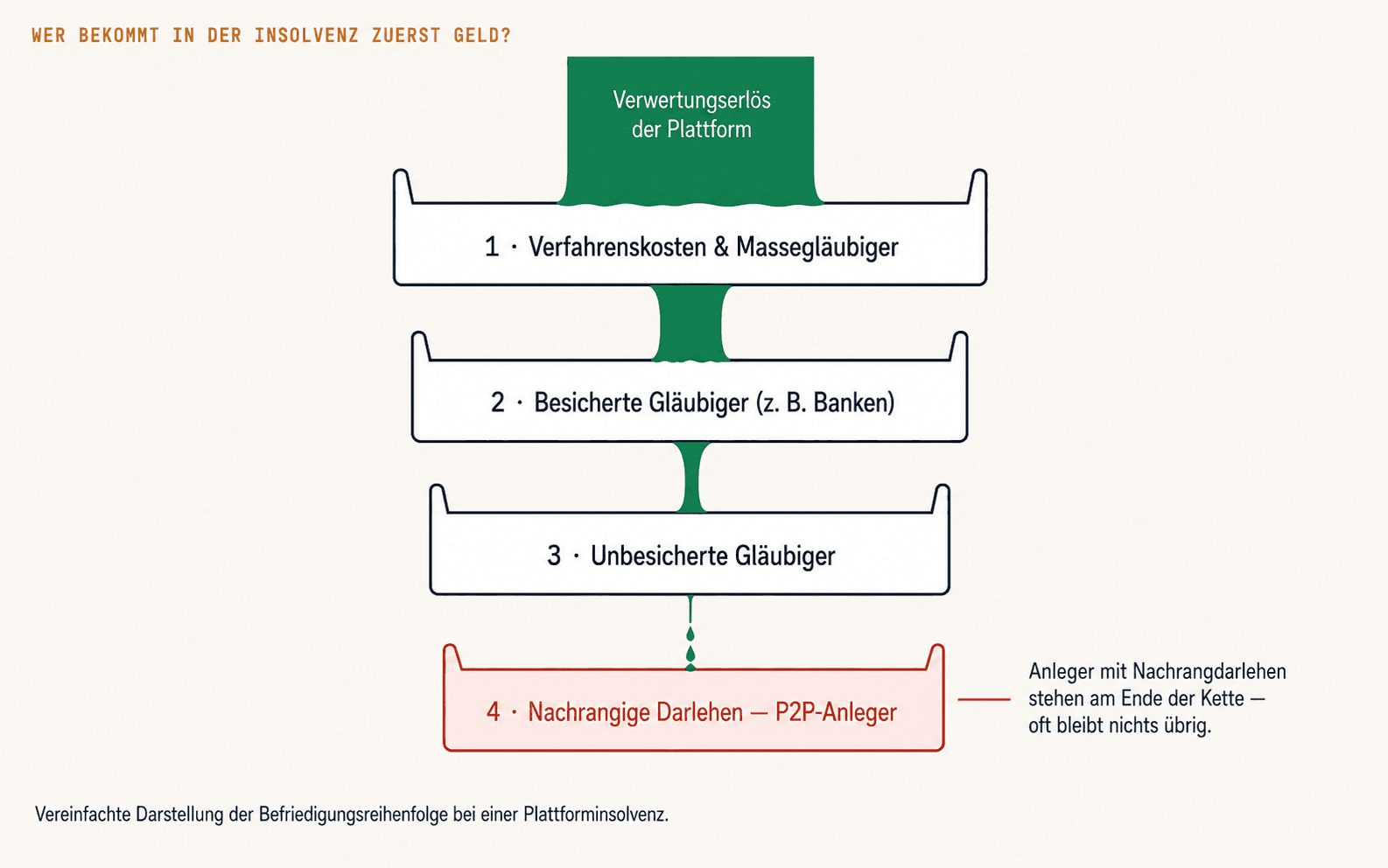
When a platform or loan originator becomes insolvent, an insolvency administrator liquidates the remaining assets and pays creditors in a legally prescribed order — the liability cascade. At the top sit the procedural costs, followed by secured creditors (such as banks holding mortgage liens), then unsecured creditors. Investors with subordinated loans stand at the end of this queue: whatever remains after all senior claims have been settled is divided among them — often only a fraction of the capital invested, in the worst case nothing.
That is precisely why the legal structure of an investment matters as much as the interest figure: it determines where in the cascade you stand. Collateral moves a claim forward; a subordination clause pushes it to the very back. The chart below shows this ranking at a glance:
Buyback guarantee and collateral: what they do — and don't
Two P2P investments with identical advertised returns can have completely different risk profiles. What matters is the mechanism behind the interest rate.
A buyback guarantee shifts the risk from the individual loan to the loan originator — but does not remove it.
A buyback guarantee is only as strong as the company that issues it.
Collateral in the form of real estate, farmland, or machinery meaningfully lowers the risk because a recoverable physical asset exists in a default. But in practice the recovery process decides the outcome — and that costs time and often part of the capital. A loan-to-value ratio of 60 % is worth more than a glossy appraisal at 90 %.
The third dimension is the investor's legal standing: whoever subscribes to a subordinated loan has neither guarantee nor collateral in a crisis — they hold a position at the end of the creditor queue. That exact structure sits at the centre of the currently largest damage case in the German P2P market.
Case study Ventus Energy: when 18 % interest becomes a total-loss risk
Ventus Energy, an Estonian platform for energy projects (wind, solar, battery storage, heat), advertised 18 to 24 % interest with daily interest payments. Germany was its largest market: roughly half of its approximately 6,500 investors came from there. Outstanding investor capital grew from 65.8 million euros in December 2025 to over 94 million euros by May 2026.
The chronology reads like a textbook of the risk types described above:
December 2025 – Signs of fraud: The finance blogger behind karsten.me documented that the CEO had edited a third-party property appraisal via PDF manipulation to replace it with a Ventus Energy letterhead — the editing history was still visible in the file. This was accompanied by purchases of assets from the founder's circle at questionable valuations.
5 May 2026 – Regulatory risk: The BaFin ordered Ventus Energy to immediately cease its unlicensed deposit-taking business and repay the funds accepted from German investors without delay. Investors first learned of this not from the platform itself, but from BaFin's publication on 18 May.
25 May 2026 – Liquidity risk: Payment service provider Paysera restricted outgoing payments; withdrawals to investors froze.
12 June 2026 – Restructuring: In a message to investors, the company announced a judicial restructuring procedure under Estonian law (Saneerimisseadus/Pankrotiseadus). All interest payments have been stopped and are being capitalised only; the early-exit function is suspended; the energy portfolio is to be sold in an orderly process. Management intends to present a repayment plan by 10 July 2026. "We are devastated and frustrated, just like many of you," the letter reads — while simultaneously citing "targeted disruption campaigns" for which criminal proceedings had been initiated in Estonia.
What investors now face depends on the legal standing of their claim: the loans are structured as mezzanine capital — in a wind-down, investors stand behind both secured and unsecured creditors. Banking lawyers have publicly warned of risks "up to and including total loss." Whether the announced sale of the energy assets will even come close to covering the 94 million euros remains open.
The lesson is uncomfortable but simple: the 18 to 24 % were never a gift — they were the price of risk. Anyone who wants to pocket the highest interest must be prepared to lose everything in a worst case.
Return and risk by platform category
Risk is not determined by the individual platform but by the category it operates in. The provider names are examples only — the underlying mechanics are what matter:
| Category | Rate p.a. | Examples | Protection | Main risk |
|---|---|---|---|---|
| Liquidity product | up to 6 % | Bondora Go & Grow | Smoothing reserve, daily availability | unsecured portfolio, availability not guaranteed |
| Consumer loans with buyback guarantee | 8–12 % | Mintos, PeerBerry, Robocash | Buyback guarantee from loan originator | Loan originator default; concentration in one group |
| Secured loans | 9–12 % | EstateGuru, LANDE | Real estate or agricultural collateral | Duration and proceeds of recovery |
| Subordinated project loans | 15–24 % | Ventus Energy | none — investors are subordinated | Total loss; last in line in insolvency |
Reading this table from top to bottom is climbing a staircase: each step brings a few percentage points more interest — and simultaneously a new risk category. From the daily-available liquidity product to the unsecured subordinated loan, not just the return potential grows but also the probability of ending up empty-handed in a crisis. The chart below makes this relationship visible:
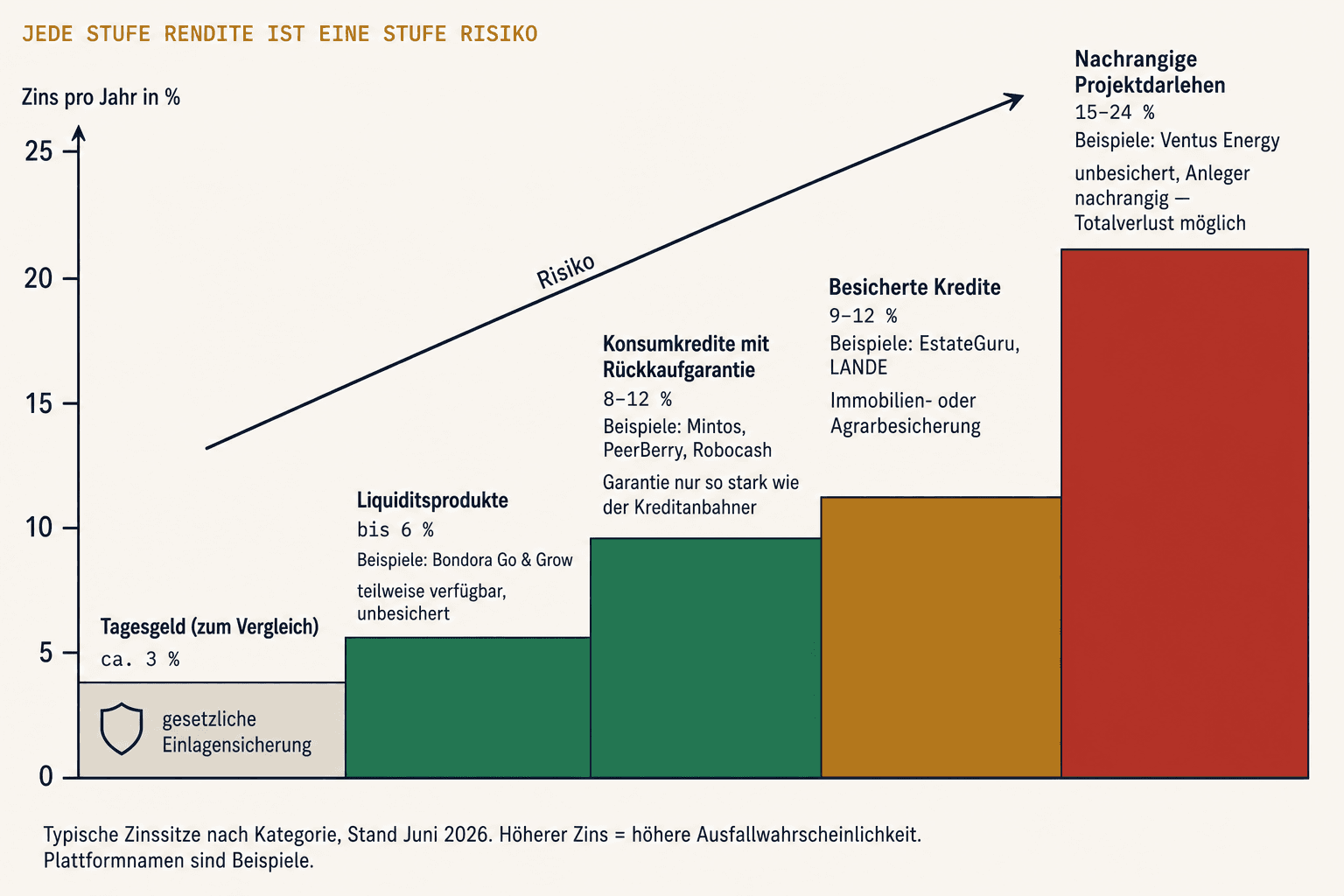
None of these platforms is "safe" — even 6 % does not come without risk. But the gap between 6 and 24 % describes fairly precisely the gap between "consumer loans with a liquidity buffer" and "unsecured subordinated loan to a company without a German licence." Detailed assessments of individual providers are in our Platform Comparison.
P2P lending: weighing return and risk properly
Take the risk premium seriously. If a platform offers twice the market average in interest, it carries at least twice the risk — usually more, because risk types stack. There is no 18 % in the credit market without a reason.
Check the structure, not the website. The contract documents are what matter: is the loan subordinated? Who is the counterparty? Is there a licence — such as an EU-wide ECSP authorisation, whose holders can be checked in the ESMA register — and audited annual reports? Does the provider publish default statistics?
Diversify — across platforms, loan originators, and countries. Diversification is the only lever that simultaneously dampens all risk types.
Avoid concentration risk
If many loans come from the same lender or corporate group, spreading across hundreds of individual loans helps little. What matters is the actual counterparty, not the number of loans.
The real return only shows after defaults, fees and taxes — and the real risk often only after years. Factoring both in from the start leads to better decisions than any return advertisement suggests. The foundations for that are in our introduction P2P Lending Explained: What lies behind the marketplace.
How can I avoid losses in P2P lending?
You cannot eliminate the risk entirely — but you can reduce it deliberately. By far the most effective lever is proper diversification, on several levels at once: across many individual loans, across multiple loan originators, across different platforms, countries and loan types. Putting 10,000 € on a single high-yield platform risks losing everything if that platform fails. Spreading the same sum across several platforms and risk classes means, in the worst case, losing only a fraction — and the running interest from the other investments cushions that loss over time.
What counts is not the sheer number of loans but the spread across genuinely independent counterparties. Which providers stack up in terms of return, protection and risk — and therefore work as building blocks of a diversified allocation — is shown in our Platform Comparison.