Strategy
Best P2P Lending Platforms 2026 Compared
The best P2P lending platforms 2026 tested: top pick Mintos (grade A), regulated alternatives, current sign-up bonuses and which platform fits which investor.

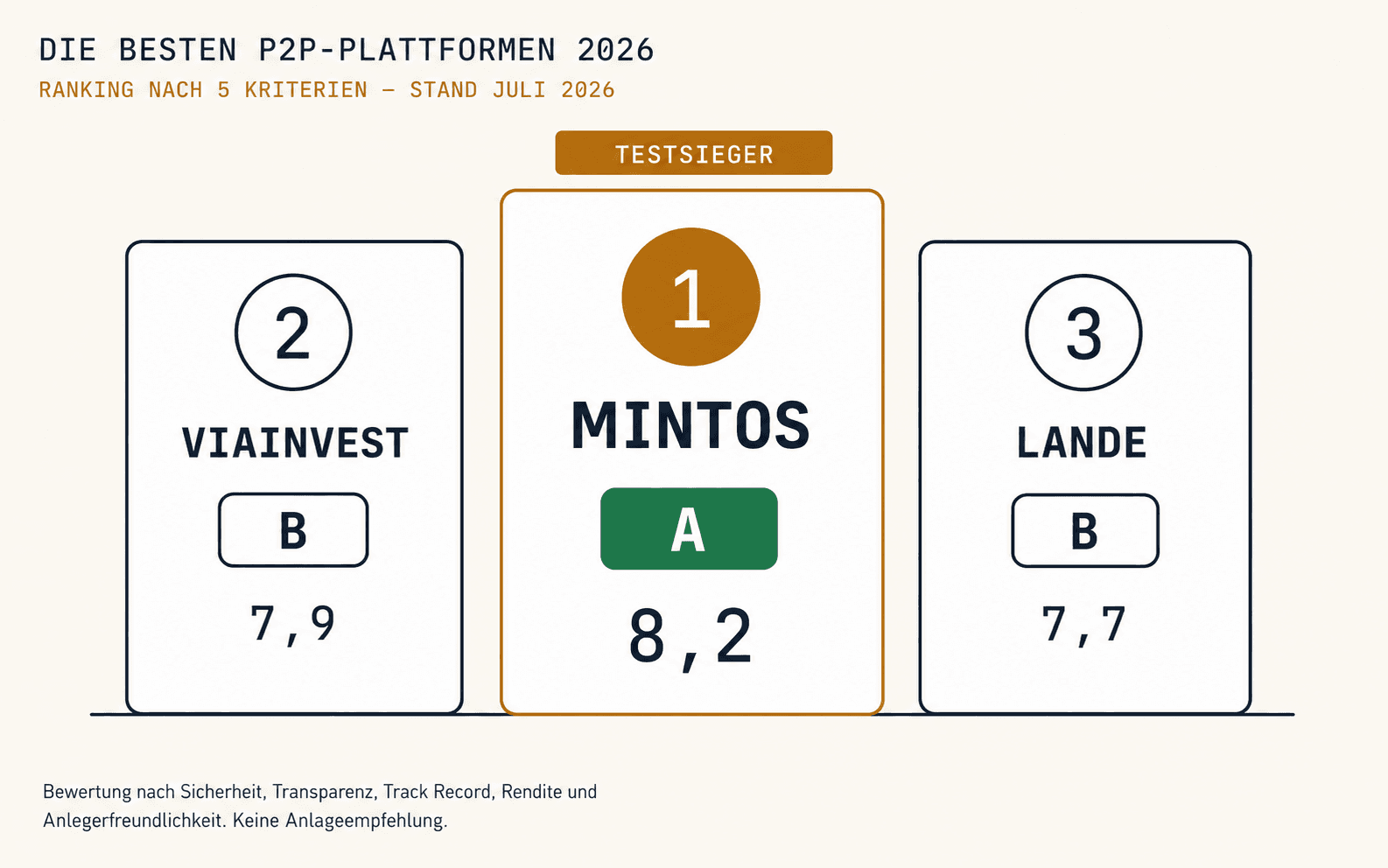
"The best P2P lending platform" is a question that cannot be answered as asked, and most rankings answer it anyway. Someone chasing double-digit rates needs a different platform from someone who mainly wants credible supervision. On the same scoring, those two investors do not end up with the same number one.
As of August 2026, P2P-Investments.de rates sixteen P2P platforms across five weighted criteria; the top pick is Mintos with grade A (8.2/10), followed by Viainvest (B, 7.9) and Lande (B, 7.7).
Which platform suits you, though, depends less on the top grade than on your investor profile. That is why the recommendations below are organised by profile - from beginner to yield-focused - each with a link to the full review and the current new-investor bonuses.
The best P2P platforms 2026 at a glance
| Investor profile | Platform | Grade | Rate ca. | From | Bonus |
|---|---|---|---|---|---|
| All-rounder & top pick | Mintos | A (8.2) | 10 % | 50 € | 1 % cashback |
| Regulated & conservative | Viainvest | B (7.9) | 12 % | 50 € | - |
| Yield with collateral | Lande | B (7.7) | 11–14 % | 50 € | 3 % cashback |
| Real estate | Crowdpear | B (7.0) | 10.6 % | 100 € | 20 € |
| Agricultural & impact | InSoil | B (7.2) | 8 % | 100 € | 50 € |
| Beginners, small amounts | Bondora Go & Grow | C (6.3) | up to 6 % | 1 € | 5 € |
All sixteen rated platforms, filterable by regulation, segment and minimum investment, are in the full P2P platform comparison.
How we select the best platforms
Every grade in this comparison follows the same rating methodology: five criteria with fixed weights - safety & regulation (30 %), transparency (25 %), track record (20 %), returns (15 %) and investor-friendliness (10 %). Each assessment rests on documented sources such as supervisory registers, audited financial statements and platform statistics; the key evidence is linked in the individual reviews.
The licence details can be verified independently, and that is the part of this rating you can reproduce yourself in five minutes: MiFID investment firms such as Mintos, Viainvest and Twino appear in the Latvijas Banka register, ECSP authorisations such as those of Crowdpear and InSoil in the Bank of Lithuania register and in the EU-wide ESMA register. How to run that check step by step is covered in the article on spotting a trustworthy P2P platform.
Two things up front so you can read the recommendations correctly. First: some links on this page are affiliate links - they fund this project but have no influence on the grades. Second: P2P-Investments.de expressly gives no investment advice. Please research the risks of P2P lending independently.
Which P2P platform is the top pick for 2026?
Mintos leads the field - as the only platform with grade A. The market leader from Riga is a licensed MiFID II investment firm: investments are structured as securitised notes with asset segregation and statutory investor compensation of up to 20,000 € if the platform itself fails. On top of that comes the best transparency in the market - Mintos is one of the few platforms that publishes its realised net returns, most recently around 9–10 % per year.
The real reason for the recommendation, however, is diversification: as Europe's largest loan marketplace, Mintos spreads your money across more lending companies, countries and loan types than any other listed platform. That breadth is the most effective protection in P2P, because the buyback obligation on late loans is carried by the respective lending company, not by Mintos. You will find the details and sources in the full Mintos review.
Which regulated platforms suit more cautious investors?
There is no deposit insurance anywhere in P2P. Investing cautiously here therefore means: genuine financial supervision, segregated custody and a solid track record. Two platforms stand out.
Viainvest (grade B, 7.9) is structurally the best-regulated consumer-loan platform in this comparison: a MiFID investment firm supervised by the Latvian central bank, regulated securities held in segregated accounts, investor compensation up to 20,000 €. The platform has run since 2016 without an investor loss, and investor reports cite realised returns of around 12 %. The flip side: all loan originators belong to the group's own VIA SMS Group, and there is no secondary market - your money is locked in for the 182-day term.
Twino (grade B, 7.1) is also a licensed investment firm, with a buyback obligation on delinquent loans, a fee-free secondary market and a 10 € minimum. Its history reaches back to 2015 and includes some hard lessons: in the Russia crisis, investors were offered only around 80 % of the affected capital. Today Twino concentrates almost entirely on Poland - tidy, but also a concentration risk.
High yields backed by land registry and registered pledge
Lande (grade B, 7.7) answers this question differently from most consumer-loan platforms: not with a buyback promise, but with land registry entries and pledged machinery. The ECSP-regulated platform finances agricultural loans secured by farmland and equipment - on average leveraged at just 43 % of the collateral value. Current projects offer 11–14 % interest, investor funds sit segregated at Lemonway, and there is no withholding-tax deduction.
You should know the price of that model: without a buyback, only the collateral counts in a default, and enforcing it through the courts can take years. Around a quarter of the outstanding volume is behind schedule, and multi-year investor experience of about 10 % sits below the advertised rates. For yield-focused investors with patience, Lande is still one of the most interesting picks of 2026 - not least with the highest cashback bonus in this comparison.
Even higher rates are advertised by Debitum at 14.8 % on business loans - and it is regulated as a MiFID II investment firm. The grade C (5.9) has two concrete reasons: around 86 % of the portfolio depends on a single issuer (the forestry fund LFDF), and since March 2026 there have been unresolved allegations of insider markups and a €24.6M inventory gap in exactly that portfolio. This is not a platform for your core holding - at most a deliberately small add-on for experienced investors who have read the details in the Debitum review.
Which platform works best for real-estate P2P?
In the property segment two platforms sit at the top of the same grade band. For a low entry barrier that is Crowdpear (grade B, 7.0): the ECSP-regulated sister platform of the PeerBerry team finances property-backed loans from 100 € at around 10.6 % interest. The combination of a Bank of Lithuania licence, first-rank mortgages and a young but clean track record sets it apart from unregulated competitors.
Just ahead of it sits InRento (grade B, 7.2), which focuses on buy-to-let - you finance rental properties and receive ongoing rental income plus a share of capital gains, though only from 500 €. Its grade rose in August 2026 because the platform now publishes its audited annual accounts back to 2020 as open downloads. EstateGuru (grade C, 6.0), long the incumbent for property-backed loans, is still working through a large recovery portfolio (over 60 % of the book) after the 2021-2022 default wave - the review shows how far the clean-up has come.
Agricultural and niche providers in brief
InSoil (grade B, 7.2) finances collateralised loans to European farmers, partly with an 80 % state guarantee on Lithuanian loans, and publishes unusually detailed quarterly portfolio reviews as well as audited annual accounts. The realistic return of around 8 % sits below the advertised 13 % - in exchange, according to the platform, no loan has been written off at a loss so far. A defensive addition for investors who value collateral over the last percentage point.
Capitalia (grade B, 7.5) is also worth a look: collateralised business loans to Baltic SMEs at around 10 % interest, ECSP-regulated, from 200 €. The platform is small and little known - but its rating is among the best in this comparison.
What is the best P2P platform for beginners?
For a first contact with P2P, Bondora Go & Grow (grade C, 6.3) is hard to beat: from 1 €, fully automatic, with daily liquidity under normal conditions. On the market since 2008 and consistently profitable since 2017, Bondora is one of Europe's oldest providers.
The grade C reflects the product's limits: Go & Grow is not investment-regulated, capped at 6 %, and an unsecured claim against a loan pool without loan-level visibility. If you want to diversify more broadly from the start, take Mintos from 50 € with auto-invest.
P2P bonuses 2026: current sign-up credit and cashback
Many platforms pay new investors a bonus via partner links. As a top-up on a platform that fits your strategy anyway, it is free money. As of July 2026, these offers are active:
| Platform | Bonus | Key condition | |
|---|---|---|---|
| Lande (B) | 3 % cashback | primary-market investments, first 30 days | Open with bonus → |
| Twino (B) | up to 2 % cashback | primary market, first 90 days | Open with bonus → |
| Mintos (A) | 1 % cashback | from 1,000 € within the first 60 days | Open with bonus → |
| InSoil (B) | 50 € bonus | from 1,000 € within 60 days | Open with bonus → |
| Crowdpear (B) | 20 € bonus | from 300 € within 30 days | Open with bonus → |
| Debitum (C) | 20 € bonus | from 1,000 € invested | Open with bonus → |
| InRento (B) | 20 € bonus | with your first investment | Open with bonus → |
| EstateGuru (C) | 0.5 % cashback + 15 € | first 90 days; 15 € from 500 € invested | Open with bonus → |
| Bondora (C) | 5 € bonus | from 50 € within 30 days | Open with bonus → |
| Robo Cash (C) | 0.5 % (up to 10 €) | from 500 € within the first 30 days | Open with bonus → |
The bonus links are affiliate links: if you invest through them, we receive a commission - this has no influence on grades or ranking. All conditions are subject to change; the up-to-date details are in each review.
How risky are P2P loans?
To state it once, plainly: P2P lending is a risk investment. There is no deposit insurance, loans can default, platforms can fail - up to and including total loss. How quickly rate promises can turn into a payout freeze is currently on display in the Ventus Energy case. Regulation, collateral and buyback obligations shift risks; they do not remove them. So the rule is: only invest money you can afford to lose, and diversify consistently across several platforms and many loans. How P2P returns come about in the first place, and which risks stand against them, is covered in the guide to returns and risks.
What sixteen ratings add up to
The most striking result of this comparison is not the order at the top but how tightly packed it is. Mintos at the top and the last grade-B place are 1.2 points apart; places two through seven span just 0.9. Choosing between Viainvest, Lande and Crowdpear is therefore not a quality decision but a question of which segment you want to cover. The gap only opens up further down, towards providers without independent EU financial supervision.
What these grades cannot do is describe the future. They measure a platform as of a reporting date. No investor has lost capital at Crowdpear so far, but the platform has also not yet lived through a full credit cycle, and at Debitum the allegations from March 2026 remain unresolved. Either could move the rating noticeably at the next update.
In practice: two to four platforms from different segments, amounts you can mentally write off, auto-invest on conservative settings, and scaling up only after a few months of your own experience. If you are new to P2P, read the P2P lending basics first. All sixteen reviews are in the full P2P platform comparison.
Frequently asked questions
Which is the best P2P lending platform in 2026?
In our rating across five weighted criteria, Mintos leads with grade A (8.2/10): a MiFID II licence, published realised net returns of around 9–10 % and the broadest diversification on the market. Viainvest (B, 7.9) and Lande (B, 7.7) follow. Which platform is best for you depends on your investor profile - beginner, safety-focused or yield-focused.
Which P2P platform is best for beginners?
The easiest entry point is Bondora Go & Grow: from 1 €, fully automatic, with daily liquidity under normal conditions - in return, the yield is capped at 6 % and the product is not investment-regulated (grade C). If you want to diversify properly from day one, start with Mintos from 50 € and its mature auto-invest.
Which P2P platforms are regulated?
Genuine financial regulation covers Mintos, Viainvest, Twino and Debitum (MiFID investment firms supervised by Latvijas Banka) as well as Lande, Capitalia, Crowdpear, InSoil, InRento and EstateGuru with an ECSP crowdfunding licence. PeerBerry, Robo Cash and IUVO operate without standalone EU financial supervision.
How many P2P platforms should I use?
Two to four platforms from different segments are enough to start - for example a broad marketplace (Mintos), a regulated consumer-loan platform (Viainvest) and a collateralised niche such as agricultural or property loans (Lande, Crowdpear). More platforms increase diversification, but also the admin overhead.
Which P2P sign-up bonuses are available in 2026?
As of July 2026, bonuses via partner links include 1 % cashback at Mintos, 3 % cashback at Lande, up to 2 % cashback at Twino, a 50 € bonus at InSoil, 20 € each at Crowdpear, Debitum and InRento, and 5 € at Bondora. Conditions (minimum investment, time window) differ per platform and can change.
How much return do the best P2P platforms deliver?
Advertised rates in 2026 mostly range from 8 to 14 % p.a. After defaults and delays, 6–12 % net is realistic: Mintos publishes realised net returns of around 9–10 %, investor reports for Viainvest cite roughly 12 %, and multi-year investor experience at collateralised platforms like Lande sits around 10 %.
Are P2P loans safe?
No - P2P lending is a risk investment without deposit insurance, and total loss is possible. Regulation, collateral and buyback obligations mitigate individual risks, but they replace neither diversification nor your own due diligence. Only invest money you can afford to lose.