Risk
How to Spot a Trustworthy P2P Platform: 7 Red Flags
How to tell a trustworthy P2P platform apart: five verifiable markers, seven red flags from real collapses and seven platforms that pass our check.

In December 2019 the analyst behind Explore P2P went looking for a company called Alborg Petrol. Investors on the P2P platform Kuetzal had lent this borrower 850,000 € at 20.5 % interest. His documented findings did not match: 1,738 € of revenue in 2018, a single employee, negative equity of 19,469 €. The copy on the company website had been lifted from a large commodity trader, the office photos came from a 3D artist's portfolio, and at the stated address in Riga reception had never heard of the company.
By January 2020 Kuetzal was gone. Envestio disappeared that same month, and in March Grupeer suspended all payments.
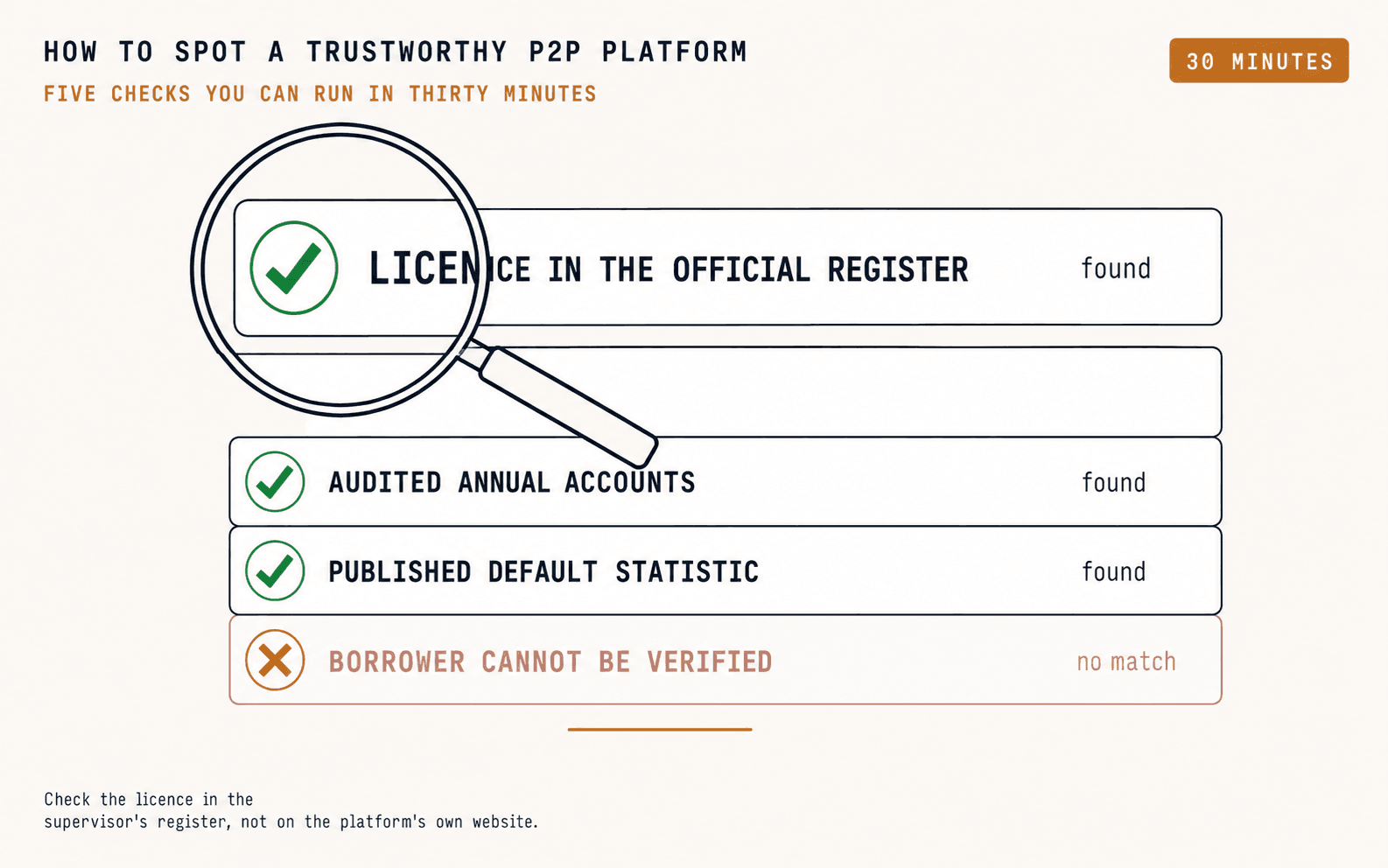
The core of that research is open to anyone – a company name, a commercial register, an annual account. You can run the same check yourself today in about half an hour. It rests on five markers: a licence in the supervisor's register, audited annual accounts, a published default statistic, named owners, and lending companies whose existence you can verify independently. All five are publicly accessible.
P2P-Investments.de has reviewed sixteen platforms under the same rating methodology; seven of them reach grade A or B.
What happened at Envestio, Kuetzal and Grupeer in 2020
The three collapses are still cited as proof that P2P lending is inherently unsafe. Lay the three chronologies side by side and a narrower pattern appears.
Envestio advertised returns of 15 to over 20 % for crypto mining rigs and "fruit factoring", without a single one of those income sources ever being evidenced. According to research by Explore P2P, the platform raised around 35 m € from roughly 15,000 investors before the website vanished in January 2020. The company claimed at the time that it was under attack; technical analysis showed the site had simply been deleted from its cloud host.
Kuetzal came apart over the borrower this article opens with. The company behind Alborg Petrol had been bought on 26 June 2019, with the loan through the platform following shortly afterwards; asked about it, Kuetzal said it had required the share transfer itself as security for the loan. The platform marketed its buyback promise as "Kuetzal Care" with no audited accounts behind it. After the findings were published, investors checked the remaining projects within weeks, demanded their money back, and the platform collapsed.
Both Estonian entities were declared bankrupt in June 2020, and Estonian police opened investigations into whether the platforms had been built to deceive from the outset.
Grupeer halted all payments in late March 2020 and pointed to the pandemic and the state of emergency, while investors waited for concrete portfolio figures. They organised into an action group that sought to recover at least 12 m € through the law firm Ellex Kļaviņš; in September 2020 the Latvian tax authority suspended the company's economic activity.
Four things were missing in all three cases: an investment licence, audited accounts, a default statistic and verifiable borrowers. For Envestio and Kuetzal that is documented in the research linked above; for Grupeer it rests on the investor group's account. An investor who had checked those four points in 2019 would not have joined any of them.
That market environment no longer exists in the same form. When those three platforms launched, the EU had no single authorisation for crowdlending. Since November 2021, providers intermediating business, property or agricultural loans need an ECSP licence, which brings an authorisation procedure, fit-and-proper checks on management, own-funds requirements, a ban on self-dealing and an annually published default statistic. The large consumer-loan marketplaces took the parallel route of a MiFID investment licence. The patterns in this article remain useful, but today they mostly apply to providers operating outside both regimes.
How do you recognise a trustworthy P2P platform?
By five markers that sit in public sources. Website design, Trustpilot stars and blogger recommendations are not among them; they tell you something about a platform's marketing, nothing about its substance.
1. A licence that appears in the official register. The word "regulated" on a website is not evidence. It becomes verifiable only in the register: if the exact legal entity name is there, you can also see which business the authorisation covers. Which licence types exist in P2P lending, and what each one actually does, is set out under ECSP licence.
2. Audited annual accounts. A statement signed off by an auditor shows whether the company behind the platform has any substance at all. In Estonia and Latvia these filings are public and often free to access. A platform that has been advertising for years without producing an audited account is not withholding a detail.
3. A published default and recovery statistic. Serious providers break their portfolio down: performing, late, in recovery, written off. For ECSP-licensed platforms this statistic has been mandatory since 2021; for everyone else, its mere existence is already a quality signal.
4. Identifiable people. Who runs the company, who owns it, and can you find those people outside the platform's own website? Company registers such as the Estonian e-Business Register answer that in minutes.
5. Verifiable lending companies and project owners. At the end of every P2P investment sits a business that is supposed to repay. Does it exist? Does it have revenue, staff, a history? That is the question on which Kuetzal came apart, and the same pattern runs through the other major failures.
The quick test before your first euro
Search the platform's legal entity name in the supervisory register, in the company register of its home country, and in an ordinary web search together with the word "annual report". What you cannot find in those three steps will not surface later either.
Seven red flags that showed up first in real collapses
The patterns below come from documented failures of European P2P platforms, and in every case they were visible before payouts stopped.
1. The rate fits no explainable business model
Double-digit rates are normal in P2P lending and have a traceable source: borrowers who cannot get credit from their bank, or not quickly, pay considerably more. The article on returns and risks breaks down where the interest actually comes from.
The rate turns into a red flag where nobody can explain who earns it. Envestio's 15 to over 20 % for "fruit factoring" and Kuetzal's 20.5 % for a company with 1,738 € of annual revenue are both cases of that kind.
2. The borrower does not exist outside the platform
Take one specific borrower and look for them outside the platform: in the company register of their country, in a web search, if need be at the stated address. It is the sharpest single test in P2P lending, and it costs ten minutes.
That is precisely the test the analyst behind Explore P2P ran on Alborg Petrol in December 2019, and the documented findings brought Kuetzal down within weeks. At a trustworthy platform the same test leads to a real company with revenue, staff and a history.
3. The platform funds projects from its own circle
When investor money flows into companies close to the operators, independent credit assessment is missing by construction. So it is worth asking who owned a borrower shortly before the loan was issued. Alborg Petrol changed hands weeks beforehand, and the explanation came only from the platform itself when investors asked.
The EU turned that lesson into a hard rule: ECSP-licensed platforms are subject to a ban on self-dealing that keeps operators and larger shareholders off their own platform as project owners. You still have to check it yourself as soon as a platform operates outside that regime.
4. It says "regulated", but there is no licence number
"Regulated", "licensed" and "supervised" are not protected terms, and two common authorisations mean something other than most people assume: a lending licence regulates the granting of loans, not your investment, and registration as a payment service provider says nothing about credit quality. Serious providers therefore name the licence type, the authority and usually the number, the way InSoil cites ECSP authorisation LB002201 from the Bank of Lithuania. Where the word stands alone without evidence, the next click belongs in the register.
5. The buyback promise has no balance sheet behind it
A buyback guarantee is a payment promise from the lending company, and therefore only as solid as that company's balance sheet. So do not ask whether there is a buyback, but who pays it and whether they can. For "Kuetzal Care" nobody could answer that question. At a trustworthy platform you can name the entity that would have to pay in a default and read its financial statement.
6. Customer acquisition runs hot while payouts slow down
Bonuses and cashback are common in P2P lending and unremarkable on their own; the providers in the P2P platform comparison use them too. What matters is the combination: sharply rising marketing spend and bonus levels alongside lengthening payout times. New capital servicing older obligations is the basic pattern of every Ponzi scheme. Checking recent forum posts about withdrawal times costs five minutes.
7. Critical questions get explanations instead of numbers
How a platform reacts under pressure often says more than any metric. Envestio and Grupeer from the first section are both cases of this kind: a claimed cyberattack that IT specialists found no evidence for in the Explore P2P analysis, and a pointer to the pandemic in place of portfolio figures.
Serious providers answer such moments with amounts, deadlines and names. A provider that shifts responsibility outward, deletes critical posts or leaves liquidity questions open is supplying the information you need.
What this check does and does not do
The five markers tell you about the platform, not about the repayment of individual loans. Even a properly licensed provider can run into a default wave. So the check filters out what should never make your list at all; the remaining credit risk you manage afterwards through diversification and through amounts you can afford to lose.
How do you check a P2P platform in 30 minutes?
Five steps, in this order. If one of them breaks down, you can skip the rest.
- Find the legal entity name (2 minutes). The imprint or the terms state which legal person sits behind the brand, for example "AS Mintos Marketplace" or "UAB Crowdpear". You work with that name from here, not the brand name.
- Verify the licence in the register (5 minutes). ECSP authorisations appear in the ESMA register, investment firms in national registers such as Latvijas Banka or the Bank of Lithuania. For providers targeting German investors, the BaFin company database is worth a look as well.
- Check for warnings (3 minutes). BaFin publishes measures against providers operating without the required authorisation in its news and warnings section. Searching the entity name there is quick and unambiguous.
- Read the company register and the accounts (10 minutes). The Estonian e-Business Register and the Latvian and Lithuanian registers give you the founding year, owners, directors and filed annual accounts. Three things are interesting: is there an audited statement, is equity positive, and does the balance sheet size match the investor volume under management?
- Statistics and a spot check (10 minutes). Open the platform's default statistic and work out what share of the portfolio is late or in recovery. Then take one current project and look up the borrower in the company register of its country.
Anyone who has walked this path twice needs less than twenty minutes on the third attempt. These same steps underpin our platform grades; which evidence counts per criterion is set out in the rating methodology.
Which P2P platforms are trustworthy?
Seven of the sixteen platforms we have reviewed reach grade A or B. All of them sit under genuine EU financial supervision, file audited or at least published financials, and can be located in the registers without ambiguity.
| Platform | Grade | Supervision | What tips the scale |
|---|---|---|---|
| Mintos | A (8.2) | MiFID investment firm, Latvijas Banka | Published realised net returns, broadest diversification |
| Viainvest | B (7.9) | MiFID investment firm, Latvijas Banka | Regulated securities in segregated accounts, no investor loss since 2016 |
| Lande | B (7.7) | ECSP, Latvijas Banka | Farmland and machinery as collateral, average LTV of 43 % |
| Capitalia | B (7.5) | ECSP, Latvijas Banka | Collateralised SME loans, in the market since 2007 |
| InSoil | B (7.2) | ECSP, Bank of Lithuania | Quarterly portfolio reviews, audited accounts |
| Twino | B (7.1) | Investment firm, Latvijas Banka | Track record since 2015, fee-free secondary market |
| Crowdpear | B (7.0) | ECSP, Bank of Lithuania | First-rank mortgages, no realised investor loss so far, short history |
Some links on this page are affiliate links. They fund this project and have no influence on the grades, which follow the published methodology alone.
Mintos is the only platform with grade A and at the same time the clearest illustration of the second point in the five-marker check: as a licensed investment firm, the marketplace publishes the net returns its investors actually realised, most recently around 9 to 10 % per year. You can reconcile that figure against your own account overview, which is what separates a verifiable number from an advertised one.
If collateral matters more to you than the last percentage point of interest, Lande and InSoil are worth a look. Both fund agricultural loans against real security, both hold an ECSP licence, and both publish the portfolio data this article describes as marker number three. The difference lies in the collateral: Lande lends against farmland and machinery at an average of 43 % of collateral value, while InSoil's land loans reach up to around 90 %. In exchange InSoil publishes audited accounts for 2021 to 2025 and unusually detailed quarterly reporting. Gross rates sit close together, 11 to 14 % at Lande against an advertised 13 % at InSoil.
For starting out with smaller amounts and clear collateral, Crowdpear is an option: first-rank mortgages, an ECSP licence from the Bank of Lithuania, from 100 € per project. That grade B is a snapshot, though. There have been defaults – the 2023 vintage came in at 8 % – but so far every one of them was absorbed through the collateral, with no capital loss for investors. Whether that holds in a broad property downturn is something the platform has yet to demonstrate. Which of the seven fits your investor profile is covered in the overview of the best P2P platforms 2026.
What to do if you have doubts about a platform
Doubts usually start with concrete observations: payouts take longer than usual, statistics disappear, answers turn vague. Four steps, in this order:
Stop the inflow. Deactivate auto-invest and automatic reinvestment so returning funds are not immediately committed again. It costs nothing and is reversible at any time.
Document. Save account statements, the portfolio overview, contract documents and the platform's communications as files. If a website disappears, those records are the basis of any later claim.
Verify the facts. Check the licence status in the register, search BaFin's warnings and look at whether the home-country supervisor has published anything. There is a world of difference between forum rumours and a supervisory measure.
Do not sell in a hurry. Selling on the secondary market at a 30 % discount locks in the loss immediately while the situation is still developing. How quickly an interest promise can turn into a payout freeze is shown by the Ventus Energy case; how hard a single failure hits your portfolio depends above all on your diversification.
The short version
If you remember one thing from this article, make it this: searching the company name in the supervisory register takes five minutes and would still have caught all three major collapses of 2020.
The rest in five lines:
- Take the legal entity name from the imprint, not the brand name.
- Verify the licence in the ESMA or national register, not on the provider's own site.
- Look for audited annual accounts in the commercial register of its home country.
- Open the default and recovery statistics and do the arithmetic.
- Pick one individual borrower and verify it independently.
If any of those five steps breaks down, that is reason enough to pass, whatever the interest rate promises. For the seven providers with grade A or B this check is documented with sources; all sixteen ratings are in the P2P platform comparison.
Frequently asked questions
How do I recognise a trustworthy P2P lending platform?
By five markers you can verify yourself: a licence that appears in the supervisor's official register (not just on the website), audited annual accounts for a named legal entity, a published default and recovery statistic, identifiable owners and directors, and lending companies or project owners whose existence you can confirm independently. If several of these are missing, that is reason enough to skip the platform, whatever the advertised rate.
Which P2P lending platforms are trustworthy?
In the P2P-Investments.de rating, seven of sixteen reviewed platforms achieve grade A or B: Mintos (A, 8.2), Viainvest (B, 7.9), Lande (B, 7.7), Capitalia (B, 7.5), InSoil (B, 7.2), Twino (B, 7.1) and Crowdpear (B, 7.0). All seven sit under genuine EU financial supervision, either as MiFID investment firms or with an ECSP crowdfunding licence.
How do I check whether a P2P platform is regulated?
In the public register of the competent supervisor, not on the platform's own website. ESMA maintains an EU-wide register of every ECSP licence; investment firms appear in national registers such as those of Latvijas Banka or the Bank of Lithuania. If you cannot find the exact legal entity name there, the licence does not exist for that business.
What are the red flags to watch for when choosing a P2P platform in Europe?
Seven patterns that showed up before real European P2P platforms collapsed: a rate nobody can explain with a real business model; a borrower that does not turn up in a company register or web search; loans funded from the operators' own circle; the word "regulated" without a licence number and authority; a buyback guarantee with no named entity or balance sheet behind it; rising marketing spend and bonuses alongside slowing payouts; and vague explanations instead of hard numbers when you ask direct questions. Any single flag is worth investigating, not necessarily a reason to avoid a platform outright - several together are.
Is a high return a red flag in P2P lending?
Not in itself. Double-digit rates are normal for collateralised agricultural or property loans, because the borrower cannot get fast bank credit. The rate becomes a red flag when the platform cannot explain who earns it: in the 2020 collapses, offers ran at 15 to over 20 % for projects whose source of income was never evidenced.
Which P2P platforms have collapsed?
The best-known cases come from the unregulated market before 2021: Envestio and Kuetzal disappeared in January 2020, both were declared bankrupt in June 2020 and Estonian police opened investigations. Grupeer suspended all payments in March 2020 and had its economic activity suspended by the Latvian tax authority that September. All three lacked an investment licence, audited accounts and a default statistic, which are exactly the markers you can check a trustworthy platform against.
What should I do if a P2P platform stops paying out?
First switch off auto-invest and reinvestment so no further capital gets committed. Then save account statements, contracts and the platform's communications, check the licence status in the register and follow announcements from the competent supervisor. Panic-selling on the secondary market at a steep discount is rarely the best answer, because it locks in the loss immediately.
Has EU regulation ended P2P fraud?
It has raised the barrier to entry substantially. Since November 2021, platforms intermediating business finance need an ECSP licence, which brings an authorisation procedure, own-funds requirements, a ban on self-dealing and a published default statistic. Loan defaults, mispricing and platform failures remain possible, and the regulation does not apply to pure consumer-loan marketplaces at all.